
The Warning Nobody Reads Anymore
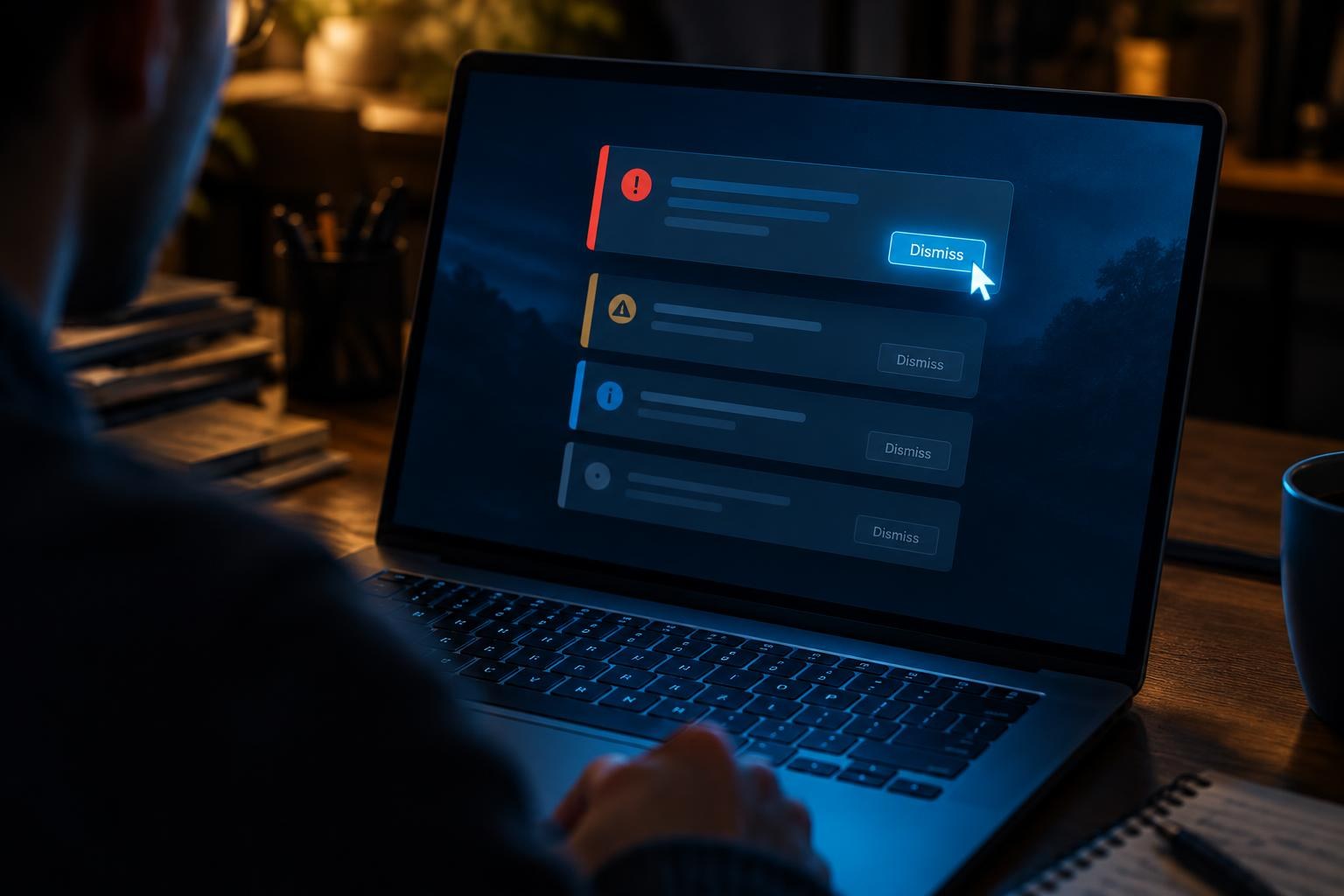
Picture a typical employee’s day. A pop-up asks them to update their password. A banner warns about a suspicious attachment. A browser flags a certificate error. By 10 a.m., they have clicked "ignore" or "proceed anyway" four times without reading a single word.
This is not laziness. It is a well-documented psychological state called security fatigue, and it is quietly undermining even the most advanced security programs. Firewalls, endpoint detection, and email filters can only go so far when the person behind the keyboard has stopped paying attention to the signals designed to protect them.
What Security Fatigue Actually Looks Like
Security fatigue rarely announces itself. It shows up as small, seemingly harmless habits:
- Clicking "remind me later" on multi-factor authentication setup, indefinitely.
- Approving app permission requests without reading them.
- Reusing the same password with a number swapped at the end, because "at least it’s different."
- Skimming phishing simulation training just to get the completion certificate.
None of these actions feel risky in the moment. That is exactly the problem. Fatigue lowers the emotional weight of security decisions until they feel like background noise rather than real choices with real consequences.
Researchers at the U.S. National Institute of Standards and Technology (NIST) coined the term after studying how users cope with the sheer volume of security decisions they face daily. Their findings still hold: when people are asked to make too many security judgments, too often, with too little context, they cope by disengaging.
Why Security Fatigue Matters More in 2026 Than Ever
The average employee today juggles more authentication prompts, compliance acknowledgments, and security pop-ups than at any point in the past decade. Multi-cloud environments, SaaS sprawl, and hybrid work have multiplied the number of systems asking users to "confirm," "verify," or "approve" something.
For organizations across the GCC investing heavily in regulatory compliance, this creates a quiet contradiction. A company can pass every audit checklist, from ISO 27001 to NESA or SAMA requirements, while its actual human risk keeps climbing because employees have mentally checked out of the controls meant to protect them.
Attackers know this. Social engineering campaigns increasingly rely not on technical sophistication but on exploiting decision fatigue: sending requests that look routine, timed for busy periods, worded to feel like "just another approval." The goal is not to trick a sharp, focused employee. It is to catch a tired one.
The Security Awareness Training Trap
Many organizations respond to security fatigue with more training. More phishing simulations. More mandatory modules. More reminders.
This often backfires. If training itself feels repetitive, generic, or disconnected from an employee’s actual role, it becomes another source of fatigue rather than a cure for it. A finance team member who sits through the same generic phishing module as a developer learns to tune it out, because the content never speaks to the specific risks they actually face.
Effective security awareness work does the opposite of adding noise. It reduces the number of decisions employees need to make correctly by making the secure choice the easy choice, and it reserves human judgment for the moments that genuinely require it.
How to Reduce Security Fatigue Without Reducing Security
A few principles consistently show up in organizations that manage this well:

Cut the Volume of Low-Value Prompts
Every warning that does not change behavior is a withdrawal from the trust account. If a pop-up is routinely dismissed without being read, it should be re-evaluated, automated, or removed rather than repeated.
Make the Secure Path the Default Path
Single sign-on, password managers, and passkeys remove the need for employees to make dozens of daily password decisions. The fewer decisions required, the more attention is left for the ones that matter.
Design Training Around Real Roles, Not Generic Checklists
A procurement officer needs to recognize invoice fraud patterns. An HR employee needs to spot fake candidate documents. Relevance keeps attention; relevance is what generic modules lack.
Explain the "Why," Briefly, Once, and Well
People disengage from rules they do not understand. A short explanation of why MFA matters, tied to a real consequence, sticks longer than a repeated instruction with no context.
Recognize Decision Timing
Fatigue peaks late in the day, right before deadlines, and during high email volume periods. Critical security decisions, such as approving unusual payment requests, deserve friction precisely at these moments, not less.
What Security Fatigue Means for Security and GRC Teams
For teams responsible for governance, risk, and compliance, security fatigue is worth treating as a measurable risk factor, not a soft HR concern. It belongs in risk registers alongside technical vulnerabilities, because it directly affects the likelihood of successful phishing, credential theft, and social engineering incidents.
Practical starting points include auditing how many security-related prompts, emails, and pop-ups an average employee encounters per week, and asking which of those genuinely required a thoughtful decision. Any prompt that consistently gets dismissed within a second is a candidate for redesign or removal.
Practical Takeaway: Reducing Security Fatigue This Week
Security fatigue is not solved by asking employees to care more. It is solved by asking them to decide less, and to decide well when it truly counts.
Three actions any organization can start this week:
Audit Prompt Volume
List every recurring security notification, warning, or approval request employees see in a normal week. Remove or automate anything that is routinely ignored without harm.
Segment Training by Role
Replace one generic, company-wide awareness module with a shorter, role-specific version for at least one high-risk department, such as finance or HR.
Add Friction Only Where It Counts
Identify the two or three decisions in your organization, such as wire transfer approvals or credential resets, that genuinely warrant a deliberate pause, and make sure those specific moments stand out from routine noise rather than blending into it.
Security fatigue will not disappear on its own. But organizations that actively manage where employee attention goes will always outperform those that simply hope employees keep paying attention to everything, all the time.