
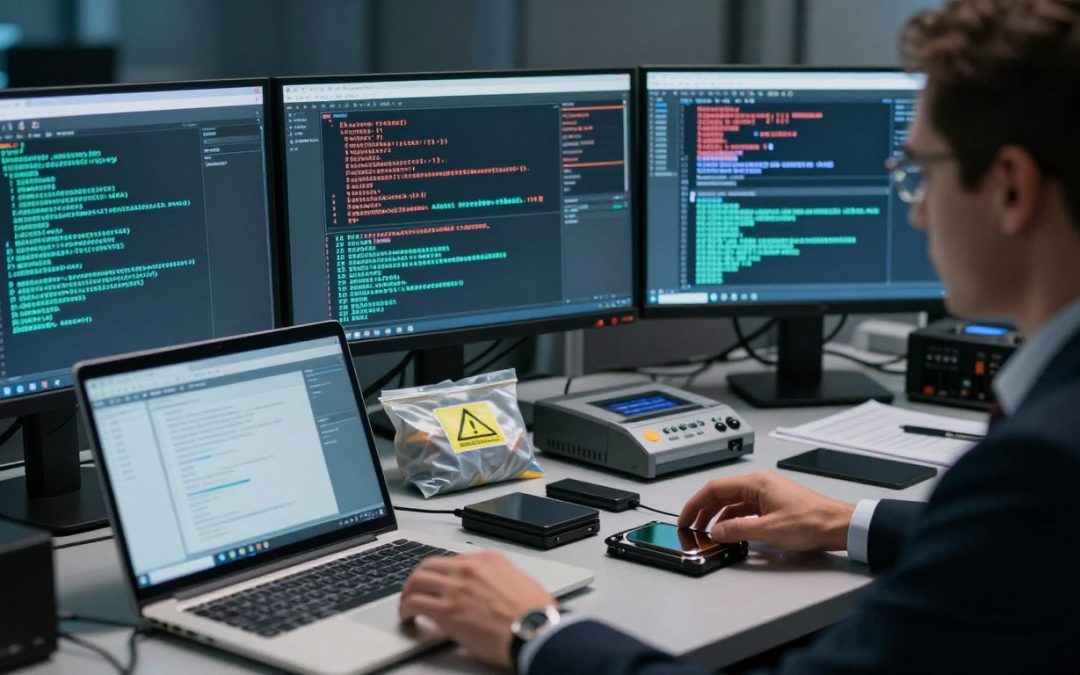
In our modern world, almost every action leaves a trail. Whether in workplace disputes or complex criminal cases, digital evidence has become the backbone of modern investigations. From cloud accounts to mobile phones, these devices store a wealth of information that can change the outcome of any inquiry.

Edit
Full screen
Delete
🔍 Digital Evidence Doesn’t Lie — But You Need the Right Tools to Make It Speak.
Reliable findings depend on how we handle this data. Computers and applications preserve records like browser history, location logs, and private messages. However, raw data is often messy and difficult to interpret without a structured approach.
This is where digital forensics plays a vital role. By using specialized methods, investigators can turn scattered technical artifacts into clear, understandable stories. Mastering these techniques ensures that your investigation remains accurate, thorough, and legally sound.
Key Takeaways
- Electronic records are now central to most legal and regulatory investigations.
- Smartphones and cloud platforms act as primary sources for critical information.
- Proper forensic processes transform raw data into reliable, actionable findings.
- Careful handling of technical artifacts is essential for maintaining integrity.
- Modern investigation success relies on interpreting complex data patterns correctly.
🔍 Digital Evidence Doesn’t Lie — But You Need the Right Tools to Make It Speak.
Every click, swipe, and login leaves a trail that can be transformed into powerful evidence. In our hyper-connected world, the devices we carry and the accounts we access act as silent witnesses to our daily lives. Understanding how to interpret this data is the cornerstone of any successful investigation.
Why Digital Evidence Matters in Modern Investigations
Digital evidence provides an objective record of events that human memory often fails to capture. It allows investigators to establish clear timelines, verify communications, and prove ownership of specific actions.
- Establishing intent: Search histories and draft messages often reveal what a person was planning.
- Mapping relationships: Call logs and social media interactions show how individuals are connected.
- Confirming presence: GPS data and Wi-Fi connection logs place a device at a specific location at a critical time.
What Digital Forensics Can Reveal
The field of digital forensics goes far beyond what a typical user sees on a screen. Experts use specialized techniques to uncover information that remains hidden during ordinary device operation.
Forensic examinations can recover deleted files, fragmented data, and hidden system artifacts. By analyzing application activity and account access logs, investigators can reconstruct a user’s behavior with high precision. These hidden clues often provide the missing link in complex legal or corporate cases.
Why Evidence Quality Depends on Process, Not Just Technology
It is a common mistake to believe that expensive software guarantees a successful outcome. A technically powerful tool cannot compensate for poor collection methods or incomplete documentation.
The integrity of your findings relies on a rigorous, repeatable process. If the initial collection is flawed, the resulting evidence may be deemed inadmissible in court. Success requires a balance of three core elements:
- Proper Methodology: Following established forensic standards for every step.
- Documentation: Keeping a detailed record of every action taken during the investigation.
- Verification: Ensuring that conclusions are supported by independent data sources rather than mere assumptions.
Define the Investigation Before Touching a Device
Successful investigations begin long before the first cable is plugged into a machine. Rushing to extract data often leads to messy results and missed clues. By taking a moment to pause, you ensure that your investigation plan remains sharp and legally sound.
Edit
Delete
Turn the Case Question Into a Focused Evidence Plan
Every case starts with a specific question that needs an answer. Whether you are looking for proof of data theft or verifying a policy violation, your goal dictates your path. A well-structured investigation plan acts as your compass, keeping you focused on the facts that truly matter.
Identify Relevant Devices, Accounts, Applications, and Cloud Services
Modern work happens across many platforms, not just on a single laptop. You must map out where the data lives, including mobile phones, cloud storage like Google Drive, and collaboration tools like Slack. Identifying these sources early prevents you from wasting time on irrelevant hardware.
Separate Relevant Evidence From Personal or Unrelated Data
It is common for a single device to hold both business records and private life details. You must be careful to isolate the information that pertains to your case. Protecting privacy is not just an ethical choice; it is a vital part of maintaining the integrity of your findings.
Set Collection Limits for Employee, Customer, and Third-Party Information
When performing digital evidence collection, you should always practice proportionality. Do not collect everything just because you can. Instead, set clear boundaries to avoid gathering sensitive health records or personal communications that have no bearing on the investigation.
By limiting your scope, you save time and reduce the risk of handling unnecessary private data. This disciplined approach makes your final report much easier to defend in a professional or legal setting. Always remember that precision is the hallmark of a skilled investigator.
Preserve Digital Evidence Without Changing It
When you encounter a digital device, your primary goal must be to keep the data exactly as you found it. Proper evidence preservation ensures that the information remains reliable and admissible in court. Any interaction with a device carries the risk of modifying files, which can undermine your entire investigation.
Secure Devices and Document Their Original Condition
Before you begin any technical analysis, you must physically secure the scene. Take clear photographs of the device, including all connected cables, peripheral attachments, and the surrounding environment. Documentation is your best defense against claims that the evidence was tampered with or moved improperly.
Use Write-Blocking to Prevent Unintentional Changes
Connecting a storage drive to a computer can automatically trigger system updates or file indexing. To stop this, you should always use a hardware write-blocker. This tool acts as a digital gatekeeper, allowing you to read data while physically preventing any information from being written back to the source drive.
Capture Volatile Data Before Powering Down a System
Some information exists only while a computer is running. If you pull the power plug immediately, you lose valuable clues that are stored in the system’s active memory. Always check for running programs and active network connections before you shut down the machine.
Prioritize Running Processes, Network Connections, and Memory
Focus your initial efforts on capturing the contents of the RAM. This volatile data often contains passwords, encryption keys, and active chat logs that disappear the moment the power is cut. By prioritizing these items, you ensure that no critical evidence is lost during the transition to a powered-off state.
Maintain a Complete Chain of Custody
A defensible chain of custody is the backbone of any forensic report. It provides a chronological history of who handled the evidence and where it was stored at all times. Without this record, the court may question the authenticity of your findings.
Record Every Transfer, Handler, Tool, and Timestamp
Every time the evidence changes hands, you must log the event. Include the name of the person, the exact time of the transfer, and the specific tools used for the collection. This rigorous chain of custody process protects the integrity of your work from start to finish.
| Action Item | Purpose | Best Practice |
| Physical Documentation | Establish baseline | Photograph all angles |
| Write-Blocking | Prevent alteration | Use hardware tools |
| Volatile Capture | Save RAM data | Prioritize memory dump |
| Custody Logging | Ensure integrity | Record every transfer |
Choose the Right Tools for Acquisition and Analysis
Navigating the complex world of digital evidence requires a precise toolkit tailored to your specific needs. Selecting the correct software ensures that your data remains intact and admissible throughout the legal process. Accuracy is your primary goal when dealing with sensitive information.
Use Forensic Imaging Tools for Computers and External Drives
When working with traditional hardware, forensic imaging serves as the gold standard for data preservation. This process creates a bit-for-bit copy of a storage medium, ensuring that every hidden file and deleted fragment is captured for later review.
Compare Full-Disk Images, Logical Extractions, and Targeted Collections
Choosing the right acquisition method depends on the scope of your investigation. A full-disk image captures everything, while logical extractions focus on active files. Targeted collections allow you to pull specific data types, which saves time when dealing with massive storage arrays.

Edit
Full screen
Delete
forensic imaging
Use Mobile Forensics Platforms for iPhone and Android Evidence
Modern smartphones present unique challenges due to their complex security architectures. Specialized mobile forensics platforms are essential for bypassing security measures and accessing encrypted partitions on both iOS and Android devices.
Account for Encryption, Locked Devices, and App-Specific Data
Encryption often hides data from standard extraction tools, requiring advanced decryption techniques. You must also consider that many applications store data in proprietary formats. Always verify that your chosen platform supports the specific app versions found on the target device.
Collect Cloud Evidence Through Provider-Supported Methods
As more data moves to the web, investigators must rely on cloud evidence to build a complete picture. Using provider-supported APIs is the most reliable way to ensure the data you collect is authentic and complete.
Preserve Audit Logs, Metadata, Access Records, and Version History
Beyond the files themselves, you should prioritize the collection of system logs and metadata. These records provide context regarding who accessed the data and when changes occurred. Version history can be particularly useful for tracking the evolution of a document over time.
Know When Commercial Tools Need Independent Verification
While commercial software is powerful, it is not infallible. You must test your tools regularly to ensure they produce consistent results across different environments. Documentation is vital; if your findings influence a legal or employment decision, you must be prepared to prove that your methods are scientifically sound.
- Validate tool outputs against known data sets.
- Document every setting and version used during the acquisition.
- Seek independent peer review for complex or high-stakes cases.
Extract the Clues Hidden in Files, Devices, and Accounts
Every file, log, and fragment left behind on a computer or phone tells a story if you know how to read it. Analysts must look beyond the surface to find the truth buried in complex file systems. This process of digital evidence analysis requires patience and a keen eye for detail.
Recover Deleted, Hidden, and Fragmented Files
When a user deletes a file, the operating system often simply marks the space as available rather than wiping the data immediately. Through deleted file recovery, examiners can often retrieve these “lost” items before they are overwritten by new information. This process is vital for uncovering evidence that someone may have tried to conceal.
“The goal of forensics is not just to find data, but to understand the context in which that data was created and destroyed.”
Analyze Metadata, Timestamps, and File-System Artifacts
Files contain much more than just their visible content. A thorough metadata analysis reveals critical information such as creation dates, last access times, and the specific software used to generate the file. These artifacts provide a chronological map of user activity that is difficult to forge.
Trace Web Browsing, Search Activity, and Application Use
Modern devices leave a trail of breadcrumbs through browser history, cached images, and application logs. By examining these records, you can determine what a user was searching for or which applications were active at a specific time. Deleted file recovery techniques can also be applied to browser databases to find history that was intentionally cleared.
Examine Email, Messaging, and Collaboration Records
Communication platforms are often the most valuable sources of information in an investigation. These records provide a direct window into the intent and actions of the parties involved. However, it is essential to handle this data with care to ensure accuracy.
Distinguish Message Content From Sender, Recipient, and Delivery Metadata
It is a common mistake to conflate the message body with its delivery details. You must separate the actual text from the technical headers that show:
- Unique sender and recipient identifiers.
- Timestamps for when a message was sent versus when it was read.
- Server-side routing information that confirms the path of the communication.
Connect Location Data, Device Identifiers, and Account Activity
The final step involves synthesizing disparate data points into a cohesive narrative. By performing a rigorous metadata analysis, you can link a specific device to a physical location or a cloud account. This comprehensive digital evidence analysis ensures that your findings are grounded in verifiable facts rather than mere assumptions.
Validate Findings With Timelines, Hashes, and Corroboration
Turning raw data into a clear story requires careful validation and logical sequencing. Investigators must ensure that every piece of information is verified before it can be used to support a conclusion. This process transforms isolated files into a cohesive narrative that stands up to scrutiny.
Build a Timeline That Shows What Happened and When
A forensic timeline is essential for reconstructing the sequence of events in any investigation. By aligning file system events, log entries, and messaging timestamps, you can create a chronological map of activity. This visual approach helps identify exactly when a specific action occurred on a device.

Edit
Full screen
Delete
forensic timeline
Use Cryptographic Hashes to Confirm Evidence Integrity
Maintaining the original state of your data is a top priority. A cryptographic hash acts as a digital fingerprint for your files. If even a single bit of data changes, the hash value will shift, alerting you that the evidence is no longer in its original condition.
Using this method ensures that your findings remain unaltered throughout the analysis. It provides a mathematical guarantee that the evidence you present in court is identical to what you collected at the scene.
Corroborate Digital Artifacts With Independent Sources
Strong evidence corroboration is the best way to build a defensible case. You should never rely on a single source of data if other records are available. Cross-referencing your findings helps eliminate doubt and strengthens your overall argument.
Compare Device Logs With Cloud Records, Network Data, and Witness Accounts
When you compare device logs with cloud backups or network traffic, you create a multi-layered view of the truth. For example, if a user claims they were not at their computer, but network logs show an active connection from their home IP address, the evidence becomes much more compelling. Witness accounts can further validate these technical findings, providing a human element to the digital trail.
Separate Confirmed Facts From Inferences and Possibilities
It is vital to distinguish between what you can prove and what you merely suspect. A confirmed fact is supported by direct evidence, such as a file creation timestamp or a login record. Inferences, while helpful for forming theories, should always be clearly labeled as such in your final analysis.
Recognize Timestamp Errors Caused by Time Zones and Clock Drift
Even the most advanced tools can be misled by inaccurate system clocks. A small time-zone difference or clock drift can shift an event by several hours, potentially creating a false sequence of events. Always verify the time settings on every device you examine to ensure your timeline remains accurate and reliable.
Keep Evidence Admissible, Ethical, and Defensible
Navigating the complex landscape of digital evidence admissibility requires a careful balance between thorough collection and respect for individual privacy. Every step you take must be grounded in legal authority to ensure your findings remain valid in a court of law. Without a clear framework, even the most compelling technical evidence can be dismissed by a judge.
Understand Consent, Warrants, Subpoenas, and Workplace Policies
Before you begin any collection, you must verify that you have the legal right to access the data. This often involves reviewing signed consent forms, court-ordered warrants, or formal subpoenas that define the scope of your search. In a corporate setting, you should also consult the organization’s internal policies regarding device usage and monitoring.
Always remember that authority is not universal. Just because you have access to a device does not mean you have permission to view every file stored on it. Staying within the boundaries of your authorization is the best way to protect your investigation from future challenges.
Protect Privacy When Evidence Includes Sensitive Personal Data
Maintaining privacy in digital investigations is a critical responsibility, especially when you encounter medical records, financial statements, or intimate communications. You must implement strict filtering processes to exclude irrelevant personal data that falls outside the scope of your inquiry. This approach minimizes the risk of exposing sensitive information that has no bearing on the case.
“The integrity of the process is just as important as the evidence itself; if you lose the trust of the court, you lose the case.”
Document Tool Versions, Settings, and Analyst Decisions
Transparency is the key to a defensible investigation. You should maintain a detailed log of every software tool used, including specific version numbers and configuration settings. This documentation allows another expert to replicate your work and reach the same conclusions.
Preserve Original Evidence While Working From Verified Copies
Never perform analysis directly on the original device or media. Instead, create a forensic image and perform all your work on a verified copy. This practice ensures that the original evidence remains in its pristine state, preventing accidental changes that could compromise its integrity.
Use Qualified Examiners and Independent Peer Review
Complex cases often benefit from the oversight of a qualified examiner or an independent peer reviewer. Having a second set of eyes on your methodology helps identify potential biases or technical errors before they become issues in court. This collaborative approach adds a layer of professional rigor that strengthens your final findings.
Know When to Involve Legal Counsel or Law Enforcement
There are times when the legal path forward is unclear, particularly when dealing with third-party data or international jurisdictions. If you encounter situations where your authority is uncertain, stop immediately and consult with legal counsel. Involving the right experts early on can save you from significant legal headaches and ensure that your work remains fully compliant with the law.
Turn Technical Findings Into Clear, Persuasive Reporting
Your technical analysis is only as valuable as your ability to communicate it clearly to those who make the final decisions. High-quality forensic reporting acts as a bridge between complex binary data and the people who need to understand the truth. By focusing on clarity, you ensure that your hard work leads to meaningful outcomes.
Write Reports That Nontechnical Readers Can Follow
Avoid using heavy technical jargon that might confuse a judge, jury, or executive. Instead, use plain American English to describe what you found and why it matters. Focus on the story the data tells rather than just listing raw technical commands.
Explain Methods, Limitations, and Confidence Levels
Transparency is the foundation of a defensible investigation. You must clearly outline the tools used and the specific steps taken to reach your conclusions. Always acknowledge any limitations in your data, such as missing logs or corrupted files, to maintain your credibility.
Defining your confidence level helps stakeholders understand the strength of your findings. Distinguish clearly between observed facts and your professional interpretations. This honesty prevents misunderstandings and builds trust in your work.
Use Exhibits That Make Digital Activity Easy to Understand
Visual aids are essential for explaining complex digital events. A well-designed chart or a clear screenshot can often communicate more than several pages of text. These exhibits allow readers to verify your findings independently.
Present Screenshots, Timeline Charts, Hash Values, and Source References
Include high-resolution screenshots to show exactly what was on the screen at the time of the incident. Use timeline charts to map out events chronologically, making it easy to see the sequence of actions. Always provide cryptographic hash values to prove that the evidence has not been altered since its collection.
| Feature | Technical Report | Persuasive Report |
| Language | Jargon-heavy | Plain English |
| Focus | Process-oriented | Outcome-oriented |
| Visuals | Raw logs | Annotated charts |
| Goal | Data logging | Clear understanding |
Prepare to Defend the Work During Depositions or Court Testimony
Providing expert testimony requires you to remain calm and objective under pressure. You should be ready to explain your methodology in simple terms if asked by opposing counsel. Preparation is the best way to ensure you remain confident during cross-examination.
Answer Questions About Reliability Without Overstating the Evidence
Never claim more than what the data can prove. If the evidence is inconclusive, state that clearly rather than guessing or stretching your findings. Reliability is your most important asset, and it is better to admit a limitation than to risk your professional reputation by overstating your case.
Conclusion
Mastering the art of digital discovery requires more than just high-end software. While powerful digital investigation tools provide the foundation for your work, the strength of your findings rests on your documented process and professional judgment.
Reliable outcomes emerge when you combine rigorous preservation methods with clear, logical reporting. You must ensure that every step of your workflow remains repeatable and transparent to withstand scrutiny in any legal setting. This commitment to integrity protects both your reputation and the privacy of the individuals involved.
Take a moment to evaluate your current approach to evidence management. Select digital investigation tools that prioritize data accuracy, security, and ease of communication. By focusing on these core principles, you transform raw data into a compelling narrative that stands up to the toughest challenges. Your ability to bridge the gap between complex technical artifacts and human understanding defines your impact as an investigator.
FAQ
Why is digital evidence considered more reliable than witness testimony in modern investigations?
While memories can fade or be biased, digital evidence provides an objective record of events. Whether it is a timestamped message in Microsoft Teams or a GPS log from an iPhone, these technical artifacts offer a factual trail. However, the evidence only “speaks” clearly when handled with professional tools like Cellebrite or Magnet AXIOM to ensure the data remains untainted and authentic.
Can you recover messages that have already been deleted from a device?
In many cases, yes! When a file is deleted on a system like Windows or Android, the data often remains in the storage space until it is overwritten by new information. Forensic examiners use specialized software to find these fragmented files and hidden artifacts. This is why it is critical to secure a device immediately and prevent further use, which could overwrite valuable clues.
What exactly is a “chain of custody,” and why does it matter?
Think of the chain of custody as a continuous logbook for a piece of evidence. It records every person who handled the device, the timestamp of when it was transferred, and the tools used, such as a Tableau write-blocker. If there is a gap in this record, a judge or regulator might question if the evidence was tampered with, potentially making it inadmissible in court.
How do investigators separate personal photos from business data on an employee’s phone?
This is where a focused evidence plan is essential. Before the investigation begins, we set strict collection limits based on relevant date ranges and specific applications, like Outlook or Slack. By using targeted collection instead of a full-device dump, we can respect the privacy of personal iCloud photos or health data while still gathering the necessary corporate records.
What is “volatile data,” and why is it the first thing investigators look for?
Volatile data refers to information stored in a computer’s RAM (Random Access Memory) that disappears the moment the power is turned off. This includes active network connections, running processes, and sometimes even unsaved documents. Expert examiners prioritize capturing this “live” data before pulling the plug to ensure a complete picture of the system’s state is preserved.
How do you prove that a digital file hasn’t been altered during the investigation?
We use something called a cryptographic hash—essentially a digital fingerprint. By running an algorithm like SHA-256 on the original data and comparing it to the copy we are analyzing, we can mathematically prove they are identical. If even a single comma in a document is changed, the hash value will be completely different, alerting us to the modification.
Can evidence be gathered from cloud services like Google Workspace or Amazon Web Services (AWS)?
Yes, but it requires specific provider-supported methods. Instead of just taking screenshots, investigators preserve audit logs, metadata, and version histories directly from the cloud environment. This ensures we see not just the final document, but also who accessed it and when changes were made, providing a much deeper level of insight.
What happens if a device’s clock is set to the wrong time zone?
Timestamp errors due to clock drift or incorrect time zone settings are common hurdles. A professional analyst will correlate device logs with external sources—like network server logs or cell tower data—to build a corrected master timeline. This prevents “impossible” sequences where an email appears to have been received before it was sent.
Do I need a warrant to look at digital evidence in a workplace investigation?
This depends on your specific workplace policies and local laws. Generally, if an employee has signed an agreement acknowledging that company-issued equipment is subject to monitoring, the employer may have the right to search it. However, for personal devices or private Gmail accounts, you may need explicit consent or a legal subpoena to stay within ethical and legal boundaries.
How is technical forensic data presented to people who aren’t “tech-savvy”?
A great forensic report translates complex code into plain American English. We use visual exhibits, such as timeline charts and screenshots, to make the findings easy to follow. The goal is to explain the “how” and “why” clearly so that executives, HR professionals, or a jury can make informed decisions based on the facts.